Volume V
Hints for Free Sparring
Select an image to view it at full size.
1. Defence
Taekwon‑Do should primarily be considered an art of defense.
This is one reason so much importance is attached to the student’s defense techniques.
With a solid, secure fighting posture the student is in a balanced position and offers only a limited number of openings for a possible attack.
Some of these openings may be selected as a means of luring an opponent into a movement that will unable the student to counter attack effectively. Because of the rather narrow choice of movements, an opponent is able to make an attack against a secure fighting stance, he is liable to move impulsively, thereby exposing himself to a quick and deadly counter‑attack.
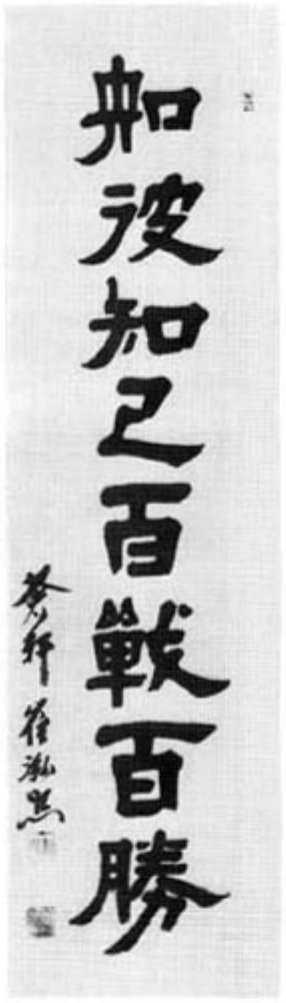
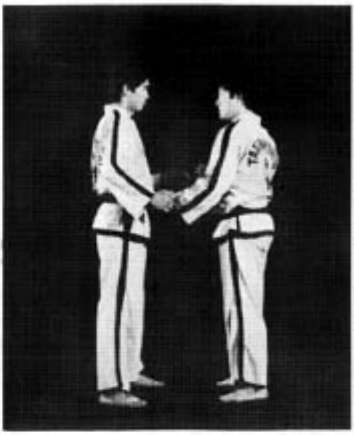
As Sontzu, the famous Chinese strategist said “victory can be one hundred percent guarantied only when knowing the capabilities of you and your enemy”, in free sparring it is advisable to take a step backwards immediately after the exchange of bows at the beginning of a match instead of rushing in with a headlong attack and then watch and study an opponent’s movements.
Know your opponent and yourself
It is certain that to win in battle 100 out of 100 times one must know the opponent as well as oneself.
It is certain that to win in battle 100 out of 100 times one must know the opponent as well as oneself.
View original source illustration
Open original image2. INSTANT ATTACK AND COUNTER‑ATTACK
In Taekwon‑Do a victory can be instantly decided by a single focused blow and lost as easily by a telegraphed kick or punch. This is the reason that students should position themselves in an impenetrable guarding posture at all times and attack only when there is a chance for a decisive blow. The student should constantly concentrate on finding or creating an opening, and should not miss the target of opportunity.
3. DECEPTION
As mentioned earlier it is quite difficult to penetrate a well guarded defense position. The only way a student can score a decisive blow against his opponent is by either breaking through the defense with sheer force or by luring his opponent out of his defensive posture by deception. A very large, strong, quick person can often break through a moderately strong defense; but a smaller person might have to rely on conducting a well‑disciplined tactical maneuver utilizing deception and flanking techniques when an opponent‑through over confidence or lack of experience‑is lured out of his free sparring position into a less defensive position, he suffers both exposure and‑through constant movement‑exhaustion.
There are a myriad of techniques the student can use in drawing out his opponent; eg., a feint with a high punch or strike could momentarily raise an opponent's guard long enough to score against the floating ribs with a side or front kick. A jumping or shout may induce the opponent to execute a premature move that the alert student can counter.
A change in guarding posture or slight feint, calculated to give the opponent impression the student is attempting to flank him, can also induce the opponent to either prematurely attack or instinctively drop his guard.
The opening the student has created may only last a spilt second, therefore, it is of utmost importance that the student's attack be carried out immediately.
4. SELECTION OF A PROPER TARGET
The student of Taekwon‑Do has a number of weapons at his disposal. Proper selection of the weapon for the proper target is of primary importance. From closer range an upset punch, knee, elbow, or even a throw would certainly be more effective than an extended kick or punch.
To attack a minute target, such as eye or windpipe a knuckle fist or forefinger would obviously be more effective than forefist or foot.
From a distance or in combat against multiple opponents flying kicks, such as two direction kick, three direction kick, punching kick or combination techniques would be most applicable. In other words, if the distance requires the artillery, use a gun and not a pistol; on the other hand, when the target is small and close enough for a pistol, it would be foolish to use a canon.
5. DIRECTION OF ATTACK AND DEFENCE
One of the advantages of Taekwon‑Do is that an attack or block can be executed from and toward any direction. For example, side piercing kick, side thrusting kick, pressing kick, side punch, side strike with a knife‑hand, back fist or side fist, and cross cut with a flat fingertip are ideal for attacking an opponent to the side. A back fist, back elbow, and back kick are useful tools against an opponent in the rear. A turning kick, reverse turning kick, vertical kick, side front or side back strike with a back fist are available for attacking an opponent at a diagonal line, and there are of course countless choices for a frontal attack.
The same thing is applicable for a blocking technique. It is, therefore, very important for a student to familiarize himself with those techniques required for attacking and blocking toward any direction even without facing the opponent in order to save time while minimizing exposure.
6. TECHNIQUE EXPERIMENTATION:
Most students have a tendency to use a tested or favorite technique only. Certainly in an actaual combat situation the best technique applicable should be used
In training, however, techniques that need polish and practice should be used, If a student finds that his right side is his most powerful, then he should attempt to use his left hand and foot. If his front kick is weak, then again, this kick should be used until it is perfected.
Many times a favorite technique is not feasible.
A turning kick, for example, might be ineffective where a side kick might be more suitable to penetrate a defense.
It is also important to practice a newly learned technique immediately before it is forgotten. If an instructor demonstrates a particular blocking or kicking combination, the student should respect his instructor's knowledge enough to practice it in free sparring. Last but not least, in matches an experienced fighter will watch and pick out his opponent's favorite technique. If it is used once too often, the opponent will anticipate it and counter‑attack.
7. DEVELOPMENT OF TACTIC AND MANEUVER
In open combat or match, the kind of technique to be used depends entirely on the actual situation, therefore it would be meaningless to practice free sparring against an opponent who moves according to a fixed scenario. Moreover, it would be indeed ridiculous if not impractical to set a sequence like the pattern of Taekwon‑Do as it is impossible to predict each movement an opponent would use in the actual free sparring situation.
Anyway, the student should pay special attention not to adhere to any fixed type of attacking combinations as far as free sparring is concerned. Because such robot form of sparring usually ends up with an adverse result when the opponent acts in a different way than expected.
Unfortunately, due to restrictions imposed upon the players, only a limited number of techniques may be exchanged briefly in free sparring. It is, therefore, best for students to practice the patterns and various samples of other sparrings illustrated in this volume to master variety of techniques correctly.
Remember that the pattern represents a free sparring against imaginary opponents while the sparring is the physical application of techniques logically, against actual moving agressors. At this point, the student must realize that the primary purpose of a free sparring is to develop tactics, maneuver, fighting skill, courage, self‑control, extemporaneous sense and indomitable spirit.
The exploitation of techniques is the secondary.
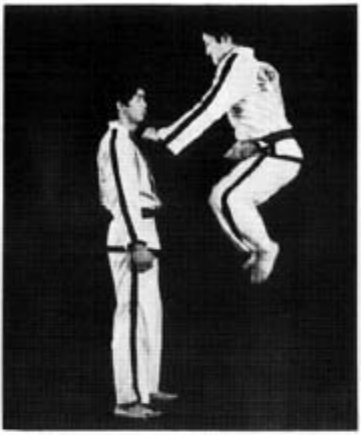
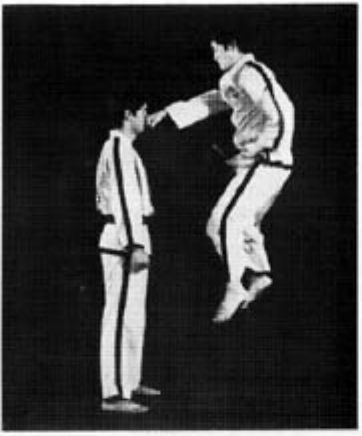
8. DODGING TECHNIQUE
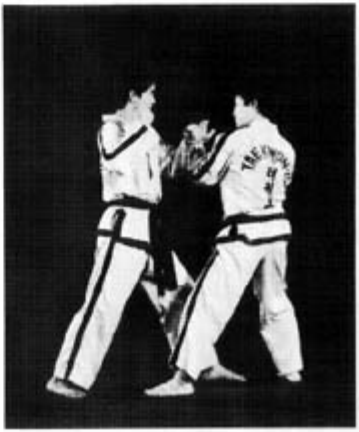
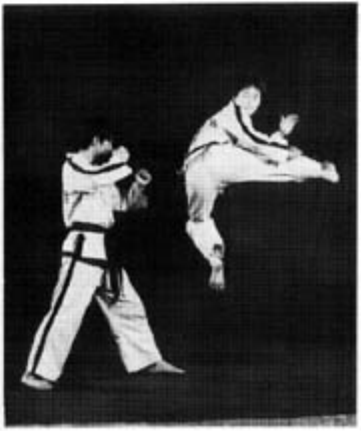
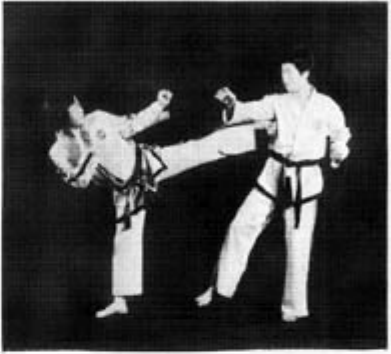
Dodging allows the attacker to use any technique freely at the proper distance and increases target opportunity.
The added advantage of this technique is not only to avoid collision at a close distance, but to allow for a surprise attack while flying away from the opponent
With this technique alone Taekwon‑Do can be clearly differentiated from any other existing martial arts.
Dodging kick
Free sparring examples, printed page 251
Dodging hand attack
Free sparring examples, printed page 251
View original source illustration
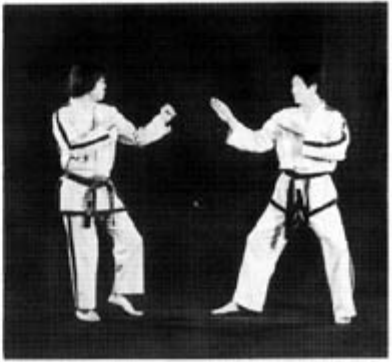
Open original image9. COUNTER ATTACK
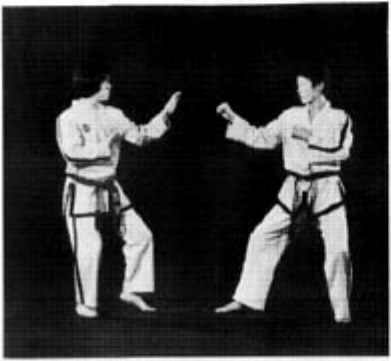
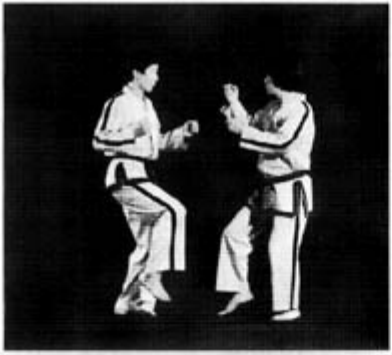
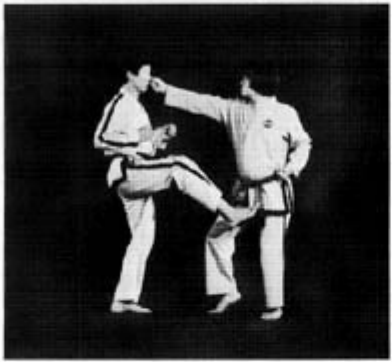
In free sparring, it is not always necessary to retreat from or block an opponent's attack. For instance, when an opponent punches or kicks, a well timed counter attack would be more effective. Remember, however, the efficiency of the counter attack is maximized only when a student attains a position of superiority in speed and timing over the opponent.
Counterattack: first example
Free sparring examples, printed page 252
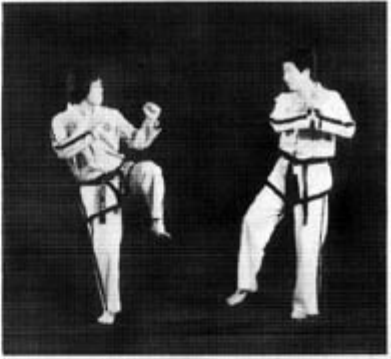
Counterattack: second example
Free sparring examples, printed page 252
View original source illustration
Open original imageSources and references
Source Pages: 246, 247, 248, 249, 250, 251, 252
References by passage
- Passage 1: 246
- Passage 2: 246
- Passage 3: 246
- Passage 4: 246
- Passage 5: 246
- Passage 6: 246
- Passage 7: 246
- Passage 8: 246
- Passage 9: 246
- Passage 10: 247
- Passage 11: 247
- Passage 12: 247
- Passage 13: 247
- Passage 14: 247
- Passage 15: 247
- Passage 16: 247
- Passage 17: 248
- Passage 18: 248
- Passage 19: 248
- Passage 20: 248
- Passage 21: 248
- Passage 22: 248
- Passage 23: 248
- Passage 24: 249
- Passage 25: 249
- Passage 26: 249
- Passage 27: 249
- Passage 28: 249
- Passage 29: 249
- Passage 30: 250
- Passage 31: 250
- Passage 32: 250
- Passage 33: 250
- Passage 34: 250
- Passage 35: 250
- Passage 36: 251
- Passage 37: 251
- Passage 38: 251
- Passage 39: 251
- Passage 40: 251
- Passage 41: 252
- Passage 42: 252
- Passage 43: 252