SOO BAK‑GI IN THE KORYO DYNASTY
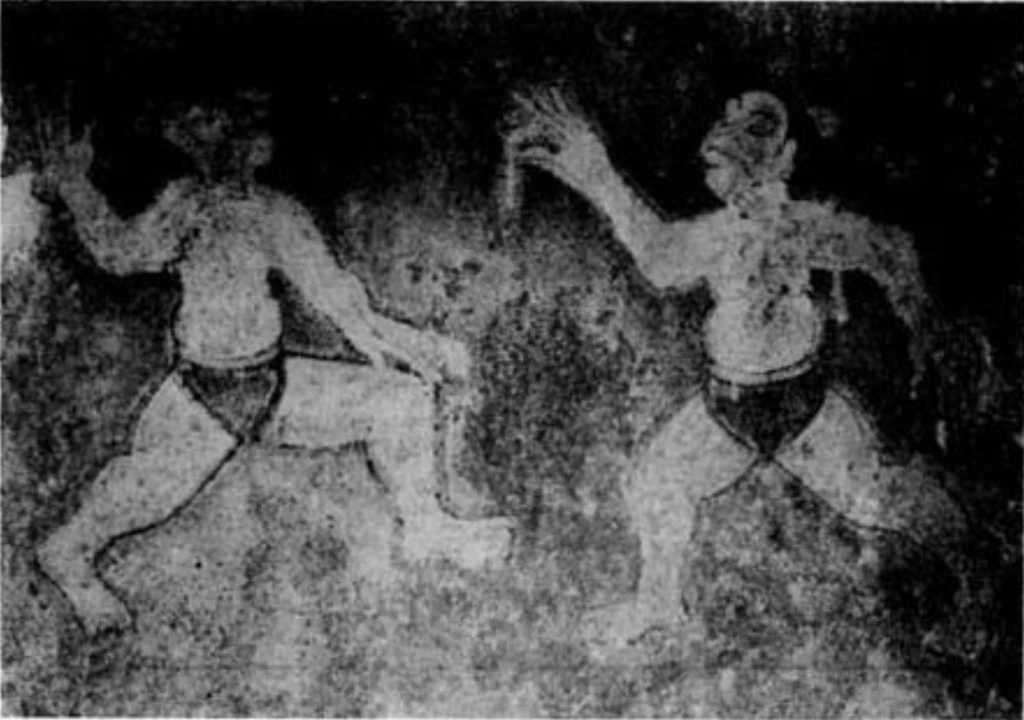
In another interesting study, Dr. An Ja San has stated in his book of ancient Korea, “Chosun Moosa Yongoung Jun” the biography of Korean warriors, that the Yoo Sul school (which could now be consideredJujitsu) was known under the name of Soo Bak‑Gi or Taek Kyon.
Annually during the month of May, the King, in person, held a match of this form of unarmed combat at the Kak Chon pavilion on Ma Am mountain. The winner of this contest was awarded a prestigious government post. The King also made the contest compulsory for all soldiers. Three of the winners of this annual contest—Lee Yi Min, JangJoong Boo andSa Kang Sung eventually became leading generals during the Koryo Dynasty. It appears that the King held more than a passing interest in the art.
These were twenty‑five fundamental movements or postures used by practitioners. Their postures incorporated hand, leg, jumping, falling, rolling and pulling techniques. Below are listed the postures:
- Chil Sung Kwon Posture
- O Hwa Yu Sin Posture
- An Hyal Chok Posture
- Dang Doo Po Posture
- Yo Dan Pyon Posture
- Il Lyong Bo Posture
- Go Sa Pyong Posture
- Do Gi Yong Posture
- Mae Bok Posture
- Gwa Ho Posture
- Goo Yoo Posture
- Gum Nal Posture
- Po Ga Posture
- Hyon Kak Hu Sa Posture
- Joong Sa Pyong Posture
- Jam Joo Posture
- Gyo Hang Posture
- Do Chok Posture
- Ki Go Posture
- Ha Sap Posture
- Bok Ho Posture
- Do Sap Posture
- Soon Ran Joo Posture
- Tam Ma Posture
- Yo Ran Joo Posture
Certainly the Silla and Koryo Dynasties marked a flowering of the martial arts in Korea. Soon after, however, these dynasties acquired anti‑military positions. Though this began a period of civil enlightenment, anything dealing with the military was debased. By the end of the Yi Dynasty the martial arts appeared to have ceased existing.
The final blow came with the Japanese occupation (1909‑1945) when it was forbidden to practice any of the martial arts. Taek Kyon was secretly practiced by some dedicated stalwarts and passed on to a handful of students.
Proponents of the art, such as Song Duk Ki, Han Il Dong and a few others, managed to keep the art alive.
After the liberation of Korea in 1945, the new Republic of Korea Armed forces was organised on January 15, 1946. A young second Lieutenant, Choi Hong Hi, recently released from a Japanese prison camp, began teaching his martial art to some of his soldiers. The rest, of course, is history, resulting in what is today known throughout the world as Taekwon‑Do.
In 1955, the name Taekwon‑Do was chosen as the new name of the national martial art by a board of instructors, historians and other prominent persons. The name submitted by General Choi was unanimously selected for its apt description of the art; Tae (foot), Kwon (fist), Do (art). Not only did this new name bear a close similarity to ancient name of Taek Kyon, but the name gave a new sense of nationalism to the art, where as the prevalent names of Dang Soo and Kong Soo connoted Chinese or Japanese martial arts.
The years of research and development by General Choi resulted in the Chang Hun style (pen name of the author) of Taekwon‑Do. Though this style is primarily based on Taek Kyon, Soo Bak‑Gi and Karate techniques, a myriad of techniques have been added, especially in the variety of hand techniques and perfection of foot techniques.
The Chan Hun style is based on twenty four patterns, each perfected and polished by General Choi Hong Hi and his colleagues, from the white belt pattern Chon‑Ji to the highest, Tong Il.
After 1,300 years, Korean martial art has reached full maturity and has spread from a small band of aristocratic warriors to practitioners in more than sixty countries with millions of students. The combination of the old classical techniques and new modifications have resulted in a form of self- defence and mental conditioning unrivaled in the modern world.
The above history was released in the weekly magazine of Chosun daily newspaper by Dr. Lee Sun Kun, President of Kyung Puk University in 1969 and one of Korea’s most noted historians.
On the other hand, Funakosi Kijin (commonly known as the father of Japanese Karate) wrote a book in 1958, claiming that Karate is the traditional martial art of Okinawa. He stated that it had been developed since the 9th century A.D. under the name of “Te” (hand). When the Okinawan techniques, modified by collaboration with Chinese Kempo (fist method), the art became known as “Dote” (Chinese hand). The first exhibition of this martial art took place in 1917 and in subsequent years it rapidly gained popularity on the Japanese mainland. In the early 1930s, the word “Do” (China) was replaced by the word “Ku” (empty) to distinguish Japanese Karate from Chinese Kempo. In Sino‑Japanese writing,”Do”or”Kara”means China.
In a book of Karate written by Nagadoni, the author states that according to legend and myth, there was a type of open hand fighting that resembled present day Sumo(Japanese wrestling) and Judo in Japan about 2,000 years ago.
Some theories are more highly glossed than others, but the continuing arguments about the origins of open hand and foot fighting are unlikely to be resolved.
A dispute over which country could claim the first use of fire would hardly be more pointless. The Chinese theory is the most readily accepted because China was the cradle of Oriental culture; but this does not necessarily mean that the martial arts had their beginning there as well. Open hand and foot fighting probably did not originate in any one country.
It is, more than likely, a natural development that occurred in different places, as the need arose for a systematic method of defence. Thus the home of each martial art will definitely depend on the nationality of its founder, but not the historical length of a country.