Volume V
Sparring: Introduction and System
Select an image to view it at full size.
Sparring (Matsogi)
Sparring is the physical application of attack and defence techniques gained from pattern and fundamental exercise against actual moving opponent or opponents under various situations. It is, therefore, not only indispensable to promote the fighting spirit and courage, to train the eyes, to read the opponents tactic as well as maneuvers, to forge, toughen or develop the attacking and blocking tools, to test his or her own skills and ability, to learn other movements hardly to be gained from pattern or fundamental exercise.
In fact, nearly all students are anxious to move into this phase of instruction. Not only does training become more interesting but for the first time the student begins to achieve a degree of satisfaction through actual application of these techniques.
The danger lies in a student who has not built up a solid basic foundation, developing bad habits that are extremely difficult to lose when a student progresses. Therefore, the instructor should encourage the beginner to learn the necessary patterns and fundamental movements before participating in class sparring, especially tournament.
General information
1. The sparring is started from a stance on line AB facing each other.
2. Blocking is begun with the left hand or left foot while attacking with the right hand or foot. There are only few exceptions to the above. A student should familiarize himself equally with both sides.
3. All kicks throughout this volume are considered to be executed with the ball of the foot for front snap kick, side front snap kick, turning kick and twisting kick while the back heel is used for reverse turning kick and pick shape kick.
System of Sparring (Matsogi Goosong)
Sparring is classified into prearranged, semi‑free, free, foot technique model and pre‑arranged free sparring with the following sub‑catagories.
Prearranged: 3‑step (alone or with companion), 2‑step and 1‑step.
Semi‑free.
Free: 1:1, 1:2, 2:2 and other combination.
Foot technique.
Model.
Prearranged free: 1:1, 1:2, 1:3 or more.
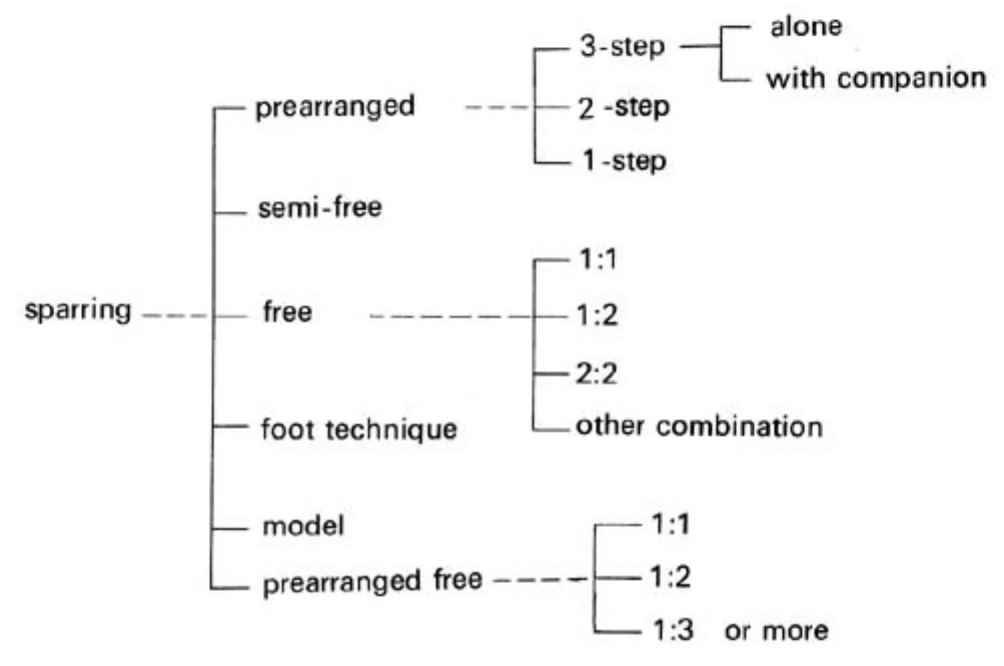
Types of Sparring
The following table is to show the appropriate kind of sparring to be taken by each grade holder, and this can be flexible according to the progress of each individuals technique.
10th grade: 3‑step alone
9th grade: 3‑step
8th grade: 3‑step
7th grade: 3‑step, 2‑step
6th grade: 2‑step, 1‑step
5th grade: 1‑step, semi‑free
4th grade: semi‑free, free
3rd grade: semi‑free, free
2nd grade: free, self‑defence techniques
1st grade: free, self‑defence techniques
Free sparring 1:2 or more, foot technique sparring and model sparring are practised among black belt holders.
Sources and references
Source Pages: 17, 18
References by passage
- Passage 1: 17
- Passage 2: 17
- Passage 3: 17
- Passage 4: 17
- Passage 5: 17
- Passage 6: 17
- Passage 7: 17
- Passage 8: 17
- Passage 9: 18
- Passage 10: 18
- Passage 11: 18
- Passage 12: 18
- Passage 13: 18
- Passage 14: 18
- Passage 15: 18
- Passage 16: 18
- Passage 17: 18
- Passage 18: 18
- Passage 19: 18
- Passage 20: 18
- Passage 21: 18
- Passage 22: 18
- Passage 23: 18
- Passage 24: 18
- Passage 25: 18
- Passage 26: 18
- Passage 27: 18
- Passage 28: 18
- Passage 29: 18
- Passage 30: 18