Volume II
Practice Suit and Belts
Select an image to view it at full size.
Practice Suit (Do Bok)
We assign names to people and objects in order to distinguish between different individuals, between objects with different properties etc. We know immediately that “Kim Sun Dal” is not the same person as “Timothy Smith”, that “flora” is distinct from “fauna”, that a “rock” and a “pillow” do not have identical characteristics.
The naming of names is a classification process by which we impose order on the universe. In the absence of names, the world would be chaotic and progress would be impossible. Our do boks serve a similar purpose. They reveal our occupation and our rank, identifying us as persons engaged in a certain kind of activity. Social order would be difficult to maintain without systemized forms of clothing.
Because of names, football can be clearly distinguished from baseball, Taekwon‑Do from Judo. Similarly, their respective uniforms allow us to distinguish a judge from a criminal, a general from a private soldier.
When we wear a uniform, we accept a certain role in society and we are obliged to behave accordingly.
Our martial art was given the name “Taekwon‑Do” to distinguish its technique, philosophical system, spiritual foundation and rules of competition from other Oriental martial arts. We have a uniform unique to Taekwon‑Do for the same reason.
Photograph
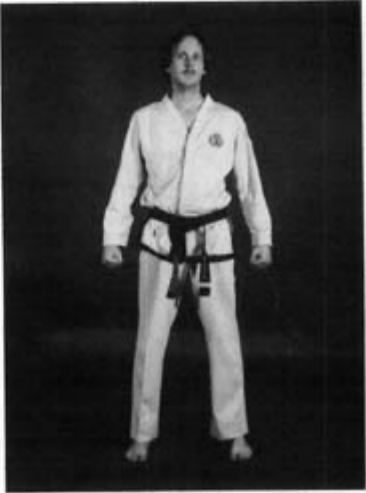
Black belt holder, first view
View original source illustration
Open original imagePhotograph
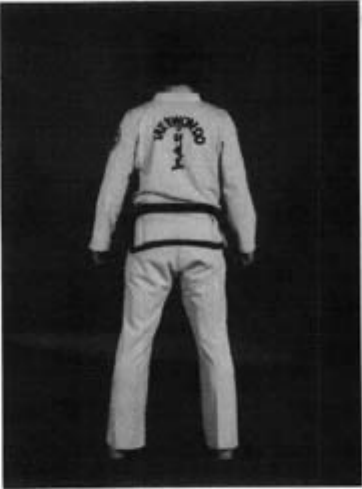
Black belt holder, second view; original printed label: Front View
View original source illustration
Open original imageThe International Taekwon‑Do Federation introduced this do bok in 1982.
It is the product of many years of research and development. This new do bok retains the aspects of the traditional do bok while representing a new age in terms of design.
It eliminates many of the inconveniences associated with other martial arts uniforms. It will not, for instance, become undone during practice or tournament.
It has also put an end to the dishonest practice of relying on starched material to create an artificial sound.
The do bok is considered a primary necessity in both training and tournament for the following reasons:
(1) The wearing of the do bok should instill pride in the student as a practitioner of Taekwon‑Do.
(2) It identifies the degree of skill and cultural education in Taekwon‑Do that the individual has attained.
(3) The style of the do bok is symbolic of Taekwon‑Do heritage and tradition.
(4) Grade and degree changes indicated by belt color create incentive while simultaneously preserving humility.
Photograph
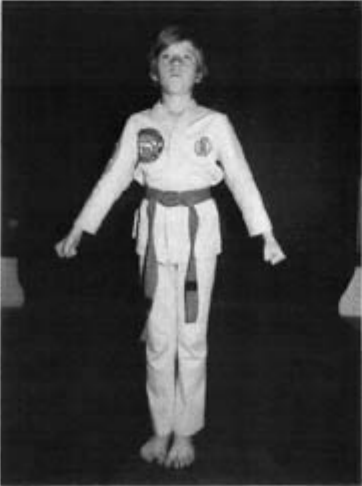
Grade holder, first view; original printed label: Back View
View original source illustration
Open original imagePhotograph
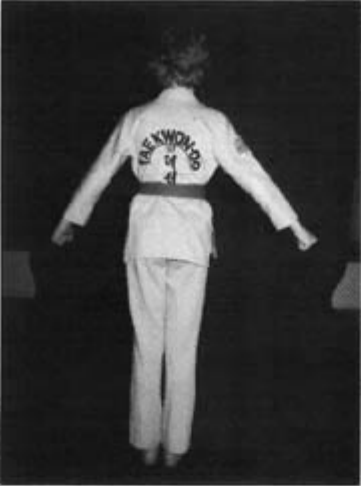
Grade holder, back view
View original source illustration
Open original image(5) The do bok is extremly practical and healthy.
(6) The official do bok distinguishes orthodox Taekwon‑Do from its imitators.
The do bok consists of a shirt, pants and belt made of a synthetic material, detron mixed with cotton. This material is a vast improvement over standard cotton in that it is more durable and flexible.
The shirt and pants must be white in color to symbolize the traditional color of the Korean costume. Superfluous frills, piping, lettering and designs are not permissible.
It is very important for the student to keep his do bok clean at all times, wear it correctly and treat it with the respect he owes to his art. Black piping around the edge of the shirt is worn only by the black belt holder.
The piping is three centimeters in width and is symbolic of the royal family and members of aristocratic houses during the Koguryo, Baekje and Silla Dynasties.
An international instructor is distinguished by black stripes three centimeters wide on both sides of the shirt and pants.
Photograph
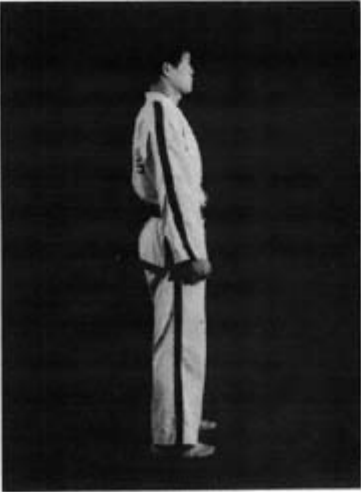
International instructor, side view
View original source illustration
Open original imagePhotograph
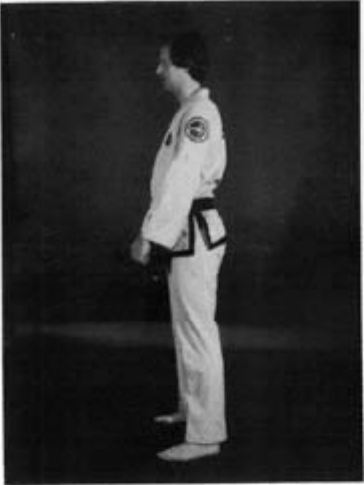
Black belt holder, side view
View original source illustration
Open original imageShirt (Sang‑i)
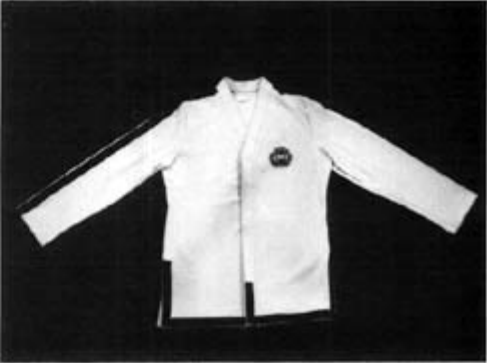
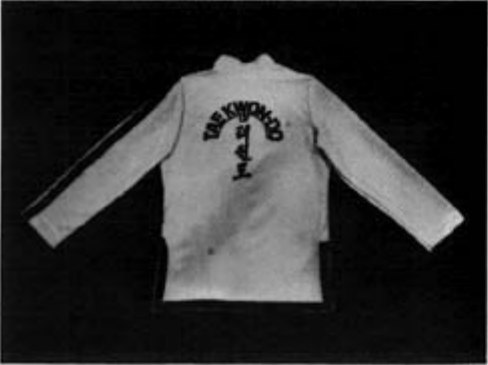
A tapered shirt is both more practical and aesthetically pleasing than a tight or loose one. The sleeves should be long enough to reach the wrist. The length of the shirt should be to the top of the thigh.
It is permissible to wear a T‑shirt under the do bok if the student desires to do so.
Pants (Ha‑i)
The length of the pants should be to the top of the ankle bone.
Uniform jacket
Shirt, front and back views. The logo symbolizes an evergreen tree.
View original source illustration
Open original imageUniform trousers
Pants, front and back views
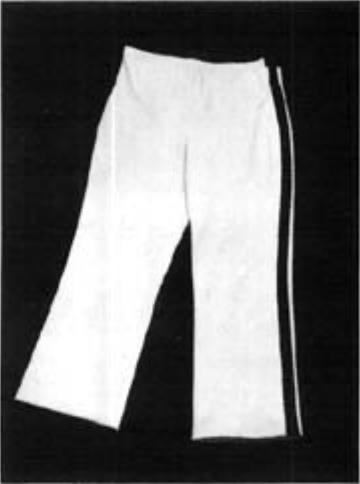
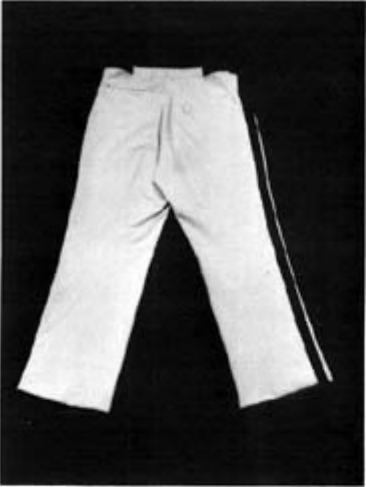
View original source illustration
Open original imageBelt (Ti)
There are six orders of belts: white, yellow, green, blue, red and black.
The width of the belt is five centimeters, the thickness five millimeters. The width of the stripe on the end of the belt is also five millimeters. The distance between the stripe and the end of the belt is five centimeters.
Black belt ranks are distinguished by Roman numerals on the belt as shown below.
Grade holder’s belts
Grade holder’s belts
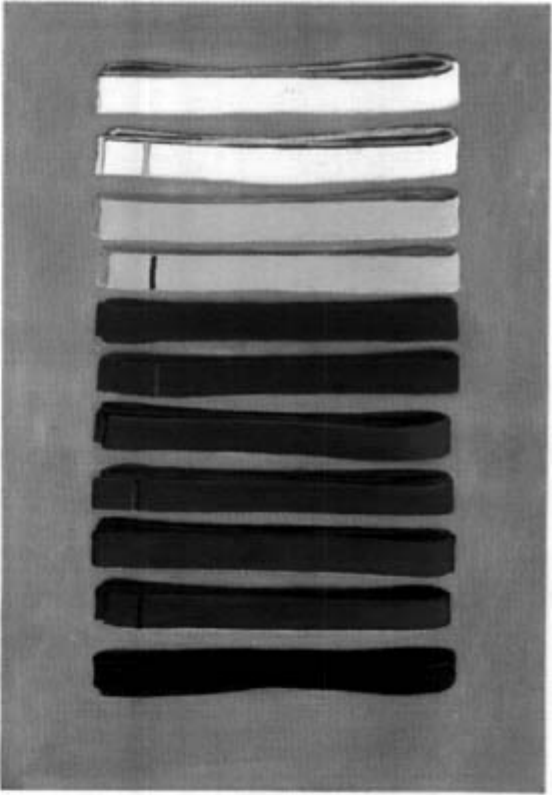
View original source illustration
Open original imageBlack belts
Black belts, First through Ninth Degree
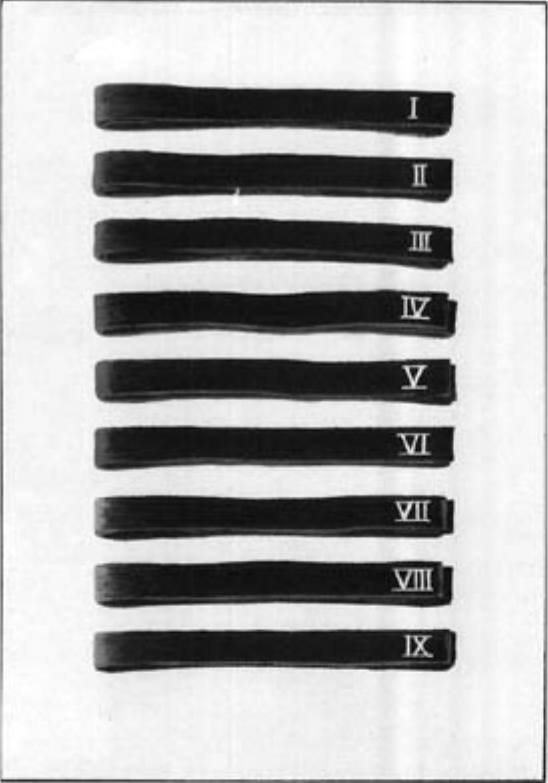
View original source illustration
Open original imageType of Belt — Rank
Black belt — First to Ninth Degree
Red belt with a black stripe — First Grade
Red belt — Second Grade
Blue belt with a red stripe — Third Grade
Blue belt — Fourth Grade
Green belt with a blue stripe — Fifth Grace
Green belt — Sixth Grade
Yellow belt with a green stripe — Seventh Grade
Yellow belt — Eighth Grade
White belt with a yellow stripe — Ninth Grade
White belt — Tenth Grade
The above colors have not been arbitrarily chosen. They are, in fact, steeped in tradition. The colors of black, red and blue denoted the various levels of hierarchy during the Koguryo and Silla Dynasties. A half black and half white belt is used for the junior black belt holder.
Meaning of Belt Colors
White — Signifies innocence, as that of a beginning student who has no previous knowledge of Taekwon‑Do.
Yellow — Signifies the Earth from which a plant sprouts and takes root as the Taekwon‑Do foundation is being laid.
Green — Signifies the plant’s growth as the Taekwon‑Do skill begins to develop.
Blue — Signifies the Heaven, towards which the plant matures into a towering tree as training in Taekwon‑Do progresses.
Red — Signifies danger, cautioning the student to exercise control and warning the opponent to stay away.
Black — Opposite of white, therefore, signifying the maturity and proficiency in Taekwon‑Do. It also indicates the wearer’s imperviousness to darkness and fear.
Sources and references
Source Pages: 176, 177, 178, 179, 180, 181
References by passage
- Passage 1: 176
- Passage 2: 176
- Passage 3: 176
- Passage 4: 176
- Passage 5: 176
- Passage 6: 176
- Passage 7: 176
- Passage 8: 176
- Passage 9: 176
- Passage 10: 177
- Passage 11: 177
- Passage 12: 177
- Passage 13: 177
- Passage 14: 177
- Passage 15: 177
- Passage 16: 177
- Passage 17: 177
- Passage 18: 177
- Passage 19: 177
- Passage 20: 177
- Passage 21: 178
- Passage 22: 178
- Passage 23: 178
- Passage 24: 178
- Passage 25: 178
- Passage 26: 178
- Passage 27: 178
- Passage 28: 178
- Passage 29: 178
- Passage 30: 179
- Passage 31: 179
- Passage 32: 179
- Passage 33: 179
- Passage 34: 179
- Passage 35: 179
- Passage 36: 179
- Passage 37: 180
- Passage 38: 180
- Passage 39: 180
- Passage 40: 180
- Passage 41: 180
- Passage 42: 180
- Passage 43: 181
- Passage 44: 181
- Passage 45: 181
- Passage 46: 181
- Passage 47: 181
- Passage 48: 181
- Passage 49: 181
- Passage 50: 181
- Passage 51: 181
- Passage 52: 181
- Passage 53: 181
- Passage 54: 181
- Passage 55: 181
- Passage 56: 181
- Passage 57: 181
- Passage 58: 181
- Passage 59: 181
- Passage 60: 181
- Passage 61: 181
- Passage 62: 181